

Beyond the Hedge
What moves us beyond our defences?

Have you ever had one of those dreams that reunites you with someone you’ve lost? Or gives you a physical grace and vitality that your body isn’t capable of in waking life? Maybe you dream of being loved or sought after in a time when you feel overlooked. And just as you’re feeling the pleasure that these dreams provide, you wake up to find yourself in a world where none of those things are true?
Usually we think of compensatory dreams as serving to restore balance when we have an excess in some area of our lives. For instance, if someone is too rigid they might dream of foolishness and chaos, or a workaholic might dream of being lost or unable to move.
But compensatory dreams also bring balance to what we lack. They offer us an embodied experience of something we are missing.
They place us in a reality so inverse to our waking circumstance that the contrast can be jarring to wake up from. Some people experience these dreams as a kind of cruelty—to inhabit however briefly, a world in which their loss doesn’t exist. Only to wake up and be confronted with it anew. But others experience these dreams as sustaining; like drinking from a pure spring that rekindles their relationship to wholeness, movement, or to a love that they’d closed off.
It might be more poetic to call these emergence dreams, because they offer us a glimpse beyond our narrow perspective, into the continuity and history of our lived experience. Without even these brief moments of transcendence, a person’s identity can collapse into their limitations.
If you are profoundly lonely, you might dream of being in true love, or surrounded by community. If your life has been driven by goals, you might dream of being carried along by a river of spontaneity. Even a dream of a departed loved one can evoke an era or atmosphere that you may have buried along with them. Without these dreams, you might lose touch with your social nature, or believe control is the only way to move through life, or forget how your sense of adventure is what brought love into your life in the first place.
These dreams—or rather, the way we respond to them—reveals the distance between the thing we most long for and the strategies we’ve built to live without it.
The very fact of being distant from what you secretly desire suggests an unwillingness to take the risks involved in meeting it. You may have even grown a private hedge against it.
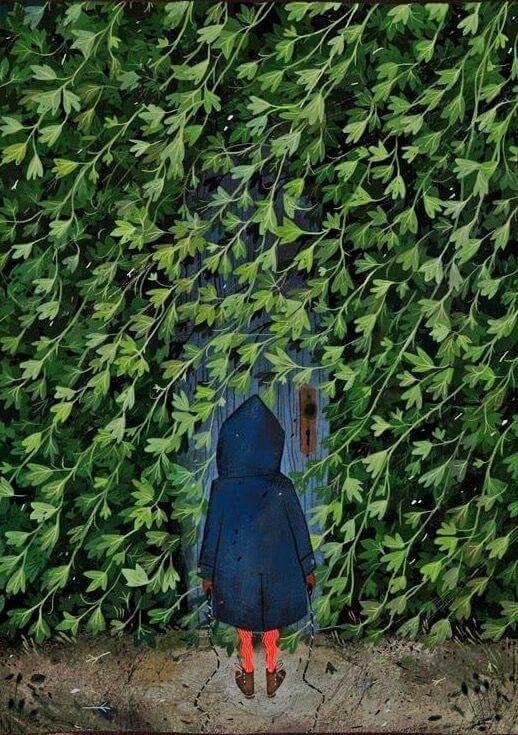
Hedging looks different for every person. Some stay busy, some hold tight to the reins, others procrastinate, hide, and make excuses, but what all hedges have in common is that they are strategies to keep heartbreak at bay.
In the story of Briar Rose, the princess pricks her finger on a spindle and falls into a deep sleep. And as she sleeps, a hedge of briar thorns grows taller and thicker around her. This impenetrable and lethal wall is a symbol for the distance we grow between our ego and the secret self. After 100 years, the true prince is able to move beyond the hedge. He is symbolic of the courageous part of ourselves, willing to risk the dangerous unknown. Willing to be heartbroken again, and again.
I’ve been watching this charming Korean Reality dating show called “Better Late than Never” about 30-something adults who have never been in a relationship. In Korean culture, someone who hasn’t dated is dubbed an “eternal single.” Though they’ve spent most of their lives avoiding being rejected, they submit themselves to a competitive dating experiment where they try to escape the scarlet brand.
The results are mixed. Few actually fall in love, but I think every participant prevails on a more meaningful ledger. They willingly confront the pernicious belief in their secret hearts that they are unloveable. And most admirably, after being churned in the painful eddies of self-doubt, they get up the next morning, brush themselves off, and reach for love again.
The eternal single braves beyond the hedge, because the real choice they are making is between isolation and heartbreak. Their safety isn’t guaranteed either way.
It’s natural to retreat after we’ve had our heart broken. At least for a period of time—hopefully less than 100 years—we may even churn around in our belief-eddies that the world is dangerous and disappointing. But there is value in hiding behind the hedge: it allows us time to sift and sort through the rubble of our experience. To decide, often after a long deliberation, what made the thing worthwhile.
But what is that impulse in us that finds our way back? Why do some people open their hearts again, to forgive and persist in love—while others nurse the cruelty? Maybe we have both these people living within each of us. The part of us that finds confirmation everywhere for how life is uniquely against us. Gathering heartbreaks in an ugly bundle, cherishing and tallying them like evidence for a case we are building. Even becoming accidentally hurtful to others as a strategy to break pain before it reaches us. And the other part, who sees the bittersweet dream as a gift.
Maybe the impulse to go beyond the hedge builds up, or shifts with alchemical timing.
Maybe we have to collect enough contradictions to our narrative until its veracity no longer holds. Or maybe life’s implicit generosity breaks through our hedge. Grief, especially witnessed, can have a loosening effect, helping us come undone from previous attachments and patterns.
But emergent dreams may give us the chiropractic jolt we need. It is Psyche’s way of connecting us to a broader field beyond the tedium of our story.
Boredom is the precursor to creativity. It’s human nature to crave novelty, to make that generative encounter with the world—and with ourselves. We have a deep impulse, like so many animals, to play. To feel ourselves in the flow of life. To be carried by its rapids, which are in turn exciting, unexpected, terrifying, and exploding with beauty. We chase the tangibility of our own lives. We need to know that we exist, and that our existence is necessary.
However fugitive, those moments of zoetic embodiment—like sitting beside an old friend, tossing pebbles into the ocean and belly laughing. Or taking shelter from a rainstorm in a cafe that serves the best breakfast you’ve ever tasted. Or being kissed so well it makes your heart race.
Unlike the routine behind the hedge, the world is a feast of unexpected encounters. Any one of them might sweep us into laughter, stop us with breathless intimacy, or touch the secrets we’ve tried so hard to protect. This is why we do it. Why we let eros, that great relational force, draw us back into the very situations that can harm and heal us. Like gravity, eros is inevitable. She is what draws us into the open, like a hare into the clearing, where we might be caught by love.
And when we are caught, we are changed. Love, no matter its duration, enlarges who we are. Like carving a bowl, each true effort at loving bears the gouges of disappointment that deepen and widen its capacity.
These dreams of impossible love, effortless movement, or reunion with lost loved ones are not to torment us with what we lack, but serve to prevent us from mistaking our hedges for the limits of who we are. It remembers what lies beyond our defenses and calls us back into conversation with our becoming.
I’m rooting for you. You deserve kisses.
So timely for me! Lately I'm getting honest with myself about why I have not had a relationship in 20 years.
I was done. Or so I thought!
My dreams lately have involved kissing or touching a partner!
So, I'm exploring this message ... And your writing is right on time for me.
Thank you!
Blessings dear one. 🙏💛